For thousands of families across Oakland County, understanding memory care in senior living feels overwhelming. The term “memory care” is often thrown around as a simple line-item amenity or a locked wing in a standard facility. But true dementia care is vastly more complex than mere supervision.
To understand what memory care in Michigan really means, families must look beyond standard assisted living options and explore how neuroscience, therapeutic architecture, and person-centered care converge. At The Oasis of Clarkston, this intersection forms the foundational standard of senior cognitive wellness.
The Paradigm Shift: Moving Beyond “Locked Wards” to Purposeful Living
For decades, traditional memory care in Michigan was defined by limitation: high-walled units, locked doors, and passive containment. This outdated approach treated memory loss as an end-state rather than a progressive condition requiring active intervention.
Modern neurological research reveals that passive environment design actually exacerbates dementia symptoms. When seniors with cognitive impairment are placed in sterile, unpredictable, or highly restrictive environments, their brain’s stress response triggers heightened confusion and distress.
| Feature | Traditional Care Model | Modern Purpose-Driven Model |
| Core Approach | Containment & Monitoring | Active Cognitive & Sensory Stimulation |
Re-framing memory care requires a fundamental shift:
- From Containment to Freedom within Safety: Replacing locked doors with intuitive visual navigation and secure, peaceful outdoor courtyards.
- From Passive Sitting to Therapeutic Engagement: Replacing routine TV time with evidence-based cognitive therapy integrated directly into daily routines.
- From One-Size-Fits-All to Person-Centered Care: Crafting daily schedules based on an individual’s lifelong history, sleep patterns, and sensory preferences.
The Clinical Science: Environmental Design and Cognitive Agitation
Understanding what is the difference between assisted living and memory care requires examining the neurological impact of physical environment. While assisted living offers support with activities of daily living (ADLs)—such as bathing or medication management—specialized memory care modifies the environment itself to function as a non-pharmacological clinical intervention.
1. The Impact of Acoustic and Environmental Design on Cognitive Agitation
Neurobiology demonstrates that damage to the temporal and parietal lobes impairs how the brain processes ambient information. High noise levels, harsh fluorescent lighting, overhead intercoms, and visual glare are not just uncomfortable—they register in a compromised brain as severe, immediate threats.
Research shows that environmental design for dementia care directly influences behavioral outcomes:
| Environmental Stressor | Neurological Impact on Dementia Patients | Evidence-Based Design Solution |
| Glare & Overhead Shadows | Causes visual hallucinations and misinterpretations of distance | Natural lighting, single-story layouts, glare-reducing floors |
| High Acoustic Echo / Noise | Elevates cortisol; triggers sensory overload and panic | Sound-dampening acoustic rhythms, serene communal layouts |
| Complex Multi-Level Hallways | Increases spatial disorientation and exit-seeking behaviors | Circular or intuitive pathways, visual navigation cues |
2. De-Escalating “Sundowning” Through Environmental Controls
One of the most complex symptoms facing families is sundowning management in memory care facilities. “Sundowning” refers to late-afternoon or early-evening agitation, anxiety, and confusion. Clinical studies indicate that sundowning is heavily driven by circadian rhythm disruption and late-day cognitive exhaustion.
By controlling ambient lighting to reflect natural circadian patterns, eliminating late-afternoon noise spikes, and offering structured sensory calming, purpose-built communities drastically reduce behavioral distress without relying primarily on chemical sedatives.
How The Oasis of Clarkston Sets the Local Standard
Translating clinical research into daily life requires intentional leadership and specialized architecture. For families evaluating memory care facilities Oakland County MI, The Oasis of Clarkston stands out as a dedicated benchmark of excellence.
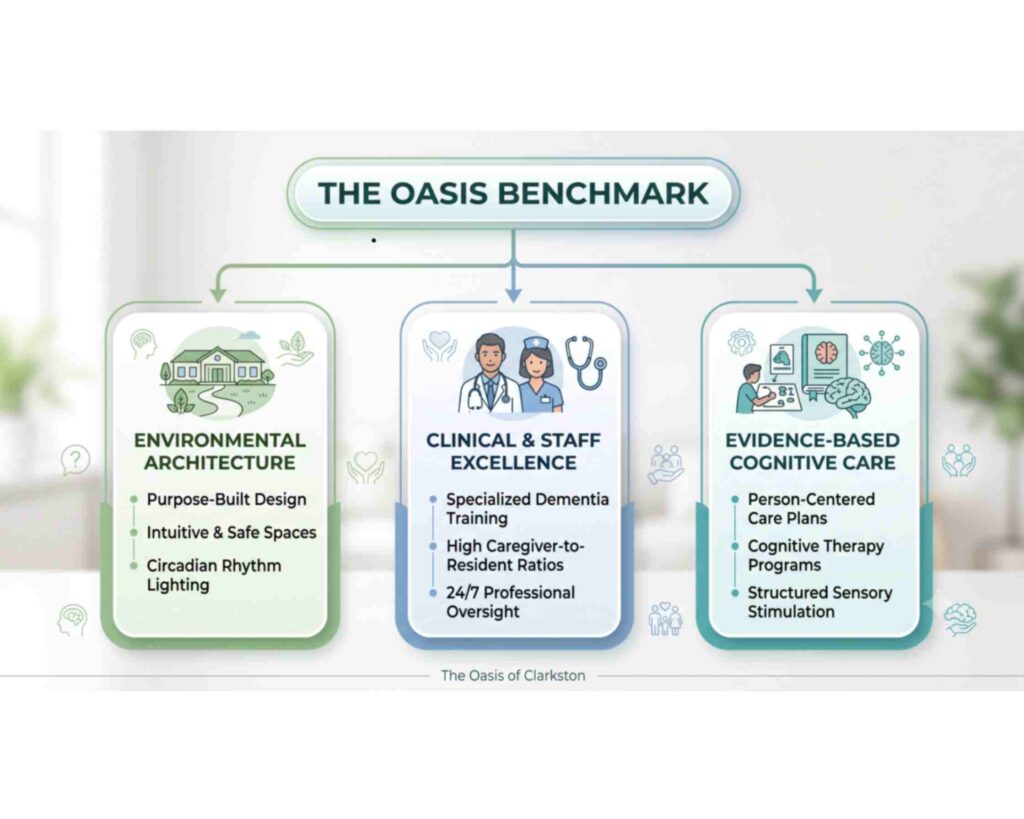
Purpose-Built Environmental Architecture
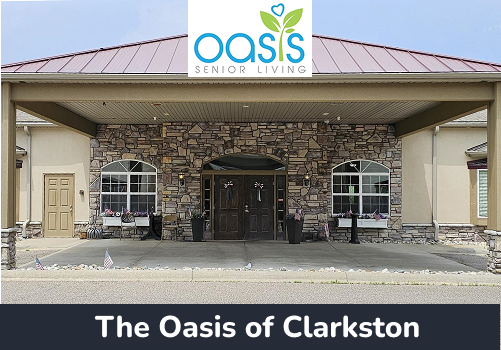
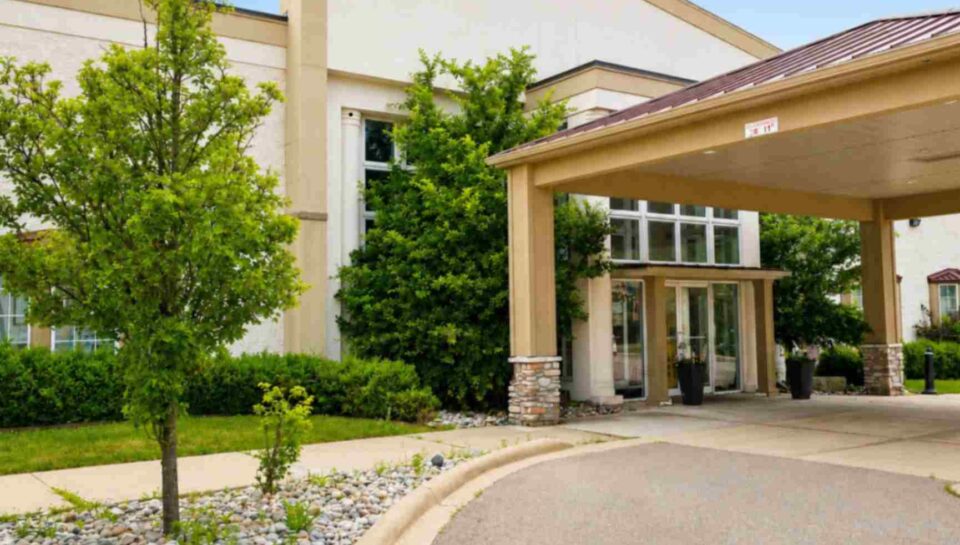
Located at 7550 Dixie Highway, The Oasis of Clarkston was constructed with environmental neurology in mind. The physical space actively supports spatial orientation and emotional tranquility:
- Single-Story Layouts & Clear Pathways: Visual cues and intuitive layouts allow residents to walk freely and safely without encountering dead ends that cause distress.
- Secure Outdoor Courtyards: Landscaping and private outdoor patios allow residents to experience fresh air and sunlight, supporting healthy circadian rhythm regulation.
- Home-like Acoustics & Comfort: Dedicated memory care studio suites (from 230 to 320 sq. ft.) are engineered to minimize background noise and provide a cozy, familiar refuge.
Clinical Expertise & Higher Staff Engagement
Real person-centered dementia care in Michigan depends on the human beings delivering it. The Oasis of Clarkston prioritizes rigorous staff training and high caregiver-to-resident ratios:
- Certified Dementia Training: Care staff receive comprehensive, specialized training to manage complex behaviors, communication shifts, and emotional cues with empathy.
- 24/7 Specialized Support: Round-the-clock professional oversight ensures quick response times during peak periods of agitation or sundowning.
- Dedicated Nursing Assessments: Every resident undergoes detailed clinical evaluations to build a customized plan that adapts as their cognitive needs evolve.
Integrating Evidence-Based Cognitive Therapy into Daily Senior Care
Care at The Oasis goes far beyond standard routines by incorporating evidence based memory care programming:
- Reminiscence Therapy: Utilizing tailored music, touch, and familiar historical objects to evoke long-term memories and spark joyful self-expression.
- Purposeful Daily Life Stations: Life-skills activities and structured art classes that give residents a daily sense of accomplishment and dignity.
- Specialized Dining Rhythms: Reduced-distraction dining environments with cueing assistance that encourage healthy nutrition and positive social connection.
Evaluating Clinical Benchmarks in Michigan Dementia Care Facilities
When local families search for the best memory care communities in Michigan, knowing what questions to ask is critical for finding long-term trust.
| # | Key Evaluation Question | What to Look For / Clinical Standard |
| 1 | Is the neighborhood standalone or purpose-built specifically for cognitive impairment? | Intuitive single-story navigation, glare-free lighting, and circular pathways that prevent disorientation. |
| 2 | How does the community handle late-afternoon sundowning without default reliance on psychotropic medications? | Environmental lighting adjustments, acoustic noise controls, and proactive sensory-calming routines. |
| 3 | What specific dementia certifications do direct care staff and leadership hold? | Specialized training in behavioral de-escalation, communication shifts, and compassionate dementia care. |
| 4 | Are secure outdoor spaces freely accessible to residents during normal hours? | Enclosed, barrier-free courtyards that encourage safe outdoor activity and natural daylight exposure. |
| 5 | How are daily activities modified to match changing cognitive capabilities over time? | Personalized therapy routines, life-skills stations, and adaptive programming scaled to individual needs. |
A Trusted Local Partner for Oakland County Families
Making the transition to specialized dementia care is one of the most emotional decisions a family can face. However, choosing a community grounded in scientific research, compassionate caregiving, and purpose-built design turns anxiety into peace of mind.
For families seeking local memory care solutions for Oakland County families, The Oasis of Clarkston provides more than a secure residence—it provides a place where loved ones can live with dignity, stability, and joy.
- Location: 7550 Dixie Highway, Clarkston, MI 48346
- Care Levels Offered: Specialized Standalone Memory Care & Assisted Living
- Schedule a Clinical Tour: Contact the Clarkston care team to explore the purpose-built memory neighborhood and discover how personalized cognitive care can transform your family’s journey.

Neil Beltran 7 August 2026