

When we want to know what are the best exercises for seniors, we often observe an older adult walking down a hallway or stepping onto a curb, we often attribute their steadiness—or lack thereof—to sheer leg strength. However, biomechanical and neurological research presents a far more complex reality. Balance is not merely a muscular function; it is a rapid-fire cognitive process managed continuously by the brain.
For seniors in West Michigan and their families, understanding the mechanics of postural control is the most crucial step toward preventing fall-related injuries and rebuilding day-to-day confidence.
1. The Neurological Triad: How the Brain Maintains Posture
Maintaining upright equilibrium requires real-time coordination among three major sensory pathways:
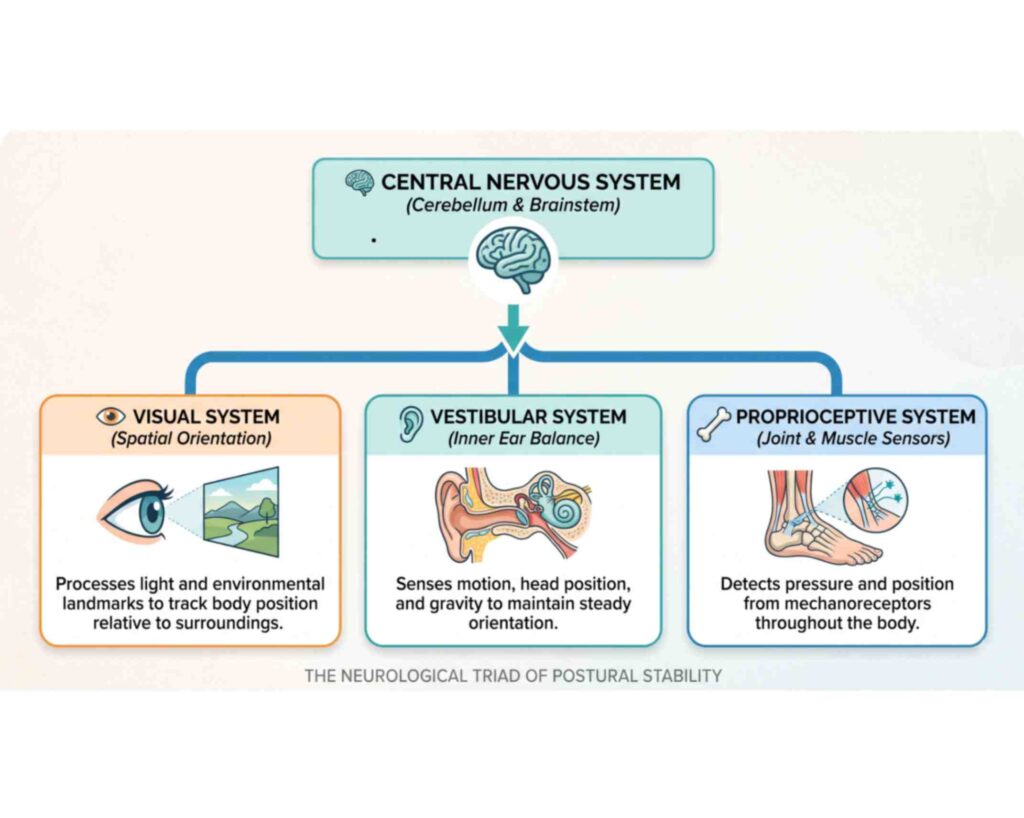
The Visual System
Provides spatial orientation relative to surrounding environmental landmarks.
The Vestibular System
Located in the inner ear, this network senses angular acceleration and gravitational pull, acting as the body’s internal spirit level.
The Proprioceptive System
A vast sensory network of mechanoreceptors located in muscles, tendons, and joint capsules that continuously transmits information to the cerebellum regarding limb placement and ground reaction forces.
The Neural Feedback Loop
With age, subtle changes occur across all three pathways. Vestibular hair cells decline, visual contrast sensitivity dims, and peripheral nerve conduction slows.
When a sensory deficit occurs, the brain experiences a processing delay. When a senior trips, a healthy sensory loop corrects the body in milliseconds. If proprioception is blunted, that corrective signal arrives too late, leading to a loss of balance.
Clinical Insight: Research on evaluating gait velocity and stance stability in fall risk mitigation demonstrates that postural instability is rarely permanent. Because the nervous system retains neuroplasticity throughout life, targeted physical training can re-wire these neural pathways, sharpening sensorimotor integration and dramatically lowering fall risk.
2. A Clinical Protocol: 4 Daily Balance Micro-Exercises
Implementing proprioceptive neuromuscular facilitation in the aging population does not require heavy weights or intense physical exertion. Instead, short, deliberate daily movements challenge sensorimotor feedback loops safely.
Below is an evidence-based exercise protocol designed to build core strength and improve proprioception.
| Progression Step | Exercise Name | Target Biomechanical Benefit |
| Step 1 | Single-Leg Stance | Micro-adjustments in ankles & feet |
| Step 2 | Tandem Standing | Dynamic base-of-support challenge |
| Step 3 | Heel-to-Toe Gait | Dynamic balance during movement |
| Step 4 | Seated Core Rotations | Trunk control & spinal stability |
Exercise 1: Single-Leg Stance Variations
- Target Benefit: Ankle mechanoreceptor sensitivity and lateral hip stability.
- How to Perform: Stand near a sturdy surface, such as a kitchen counter. Lightly place hands on the counter, shift weight onto the left leg, and lift the right foot a few inches off the floor. Hold for 10 to 15 seconds. Switch legs.
- Progression: As confidence builds, reduce hand contact to a single fingertip, or gently close eyes to force the brain to rely solely on vestibular balance training for older adults.
Exercise 2: Tandem Standing (Heel-to-Toe Stance)
- Target Benefit: Narrowing the base of support to refine central nervous system balance responses.
- How to Perform: Stand upright near a wall or counter for safety. Place the heel of the right foot directly in front of the toes of the left foot, as if standing on a tightrope. Distribute weight evenly across both feet and hold for 15 to 30 seconds. Repeat with the opposite foot forward.
Exercise 3: Heel-to-Toe Gait Drills
- Target Benefit: Dynamic spatial awareness and gait stabilization.
- How to Perform: Step forward in a straight line, carefully placing the heel of the front foot so it touches the toes of the rear foot with each step. Take 10 steps forward, pause, turn around safely, and return.
Exercise 4: Seated Core Rotations & Stabilization
- Target Benefit: Deep abdominal activation (simple core exercises for senior balance) necessary for quick postural corrections.
- How to Perform: Sit upright in a firm, armless chair with feet flat on the floor, shoulder-width apart. Engage the core muscles by pulling the navel slightly toward the spine. Slowly rotate the torso to the left, hold for 3 seconds, return to center, and rotate to the right. Complete 10 to 12 controlled repetitions.
3. The Impact of Daily Movement Protocols
Consistently practicing a daily fall prevention routine for seniors yields quantifiable physical and psychological benefits:
| Health Category | Primary Outcome | Physiological Mechanism |
| Balance & Stability | Fall Prevention | Accelerates cerebellar reaction time to external trips and stumbles. |
| Proprioception | Spatial Awareness | Re-sensitizes mechanoreceptors in ankles, knees, and hips. |
| Core Strength | Postural Control | Reinforces trunk stability to mitigate sudden center-of-mass shifts. |
| Psychological Health | Rebuilding Independence | Reduces the fear of falling, which often leads to sedentary behavior. |
4. Built-in Safety: How Environment Supports Stability
While targeted exercises build internal strength, physical surroundings play an equally crucial role in fall mitigation. Removing environmental hazards allows older adults to put these sensorimotor skills into practice safely.
Key environmental features that support safer movement include:
- Single-Story, Level Layouts: Eliminating staircases reduces one of the highest statistical sources of fall injuries in older adults.
- Spacious, Accessible Floor Plans: Wide hallways and threshold-free flooring allow for natural gait velocity without sudden trip hazards.
- Built-in Support Systems: Strategically placed handrails, walk-in showers, and non-slip surfaces provide reliable physical anchor points during daily routines.
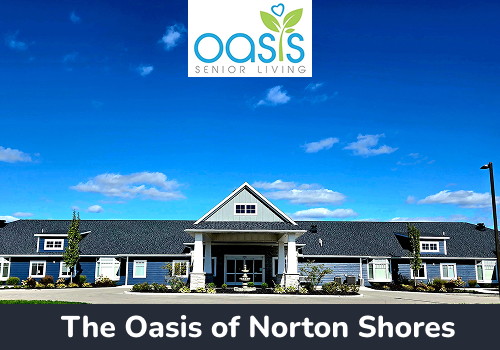
For families exploring assisted living in Norton Shores, MI, physical design and structured wellness programming work hand in hand. The Oasis of Norton Shores incorporates these environmental features within a single-story layout, offering a secure backdrop where residents can build real confidence through structured daily activity.
Empowering Independence Through Movement
Experiencing a decline in balance does not mean a permanent loss of independence. Through small, daily movements that challenge proprioception, strengthen the core, and stimulate inner-ear pathways, older adults can protect their mobility and stay active.
Whether exploring senior wellness programs in West Michigan or seeking dependable resources for senior living in Muskegon County, MI, focusing on daily balance training offers a clear path toward lifelong confidence and vital independence.

Neil Beltran 11 August 2026